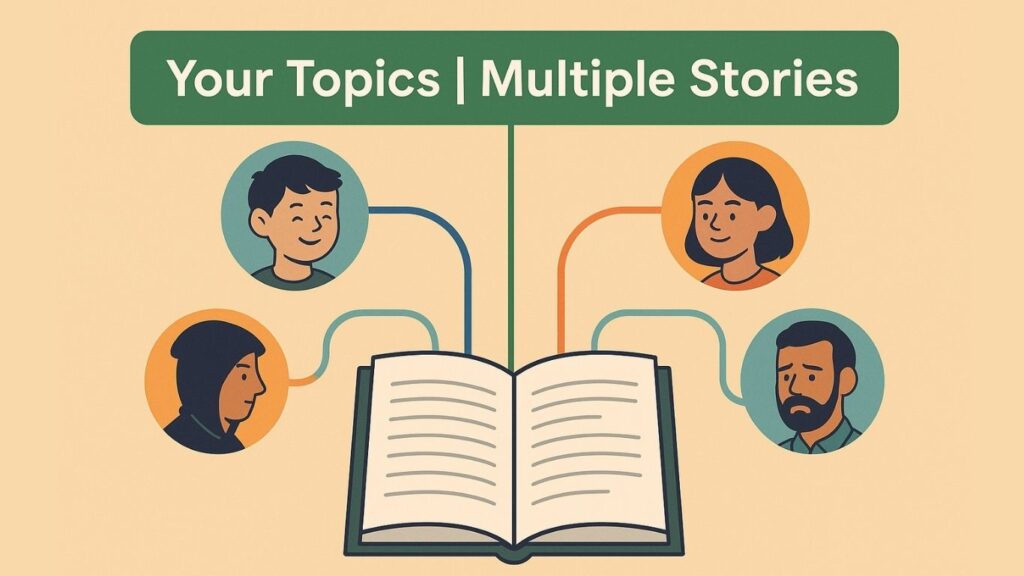
Storytelling has always been the heart of communication. Every idea, every subject, and every message finds its most powerful expression through stories. But in today’s information-rich world, one story alone rarely captures the full depth of a topic. This is where the concept of “Your Topics | Multiple Stories” comes in — a framework that encourages creators, writers, educators, and marketers to explore multiple narratives around a single subject.
In this article, we’ll dive deeply into what this approach means, why it’s important, and how you can effectively use it to enrich your writing, marketing, or creative projects.
Understanding the Concept of “Your Topics | Multiple Stories”
The idea behind “Your Topics | Multiple Stories” is beautifully simple yet incredibly powerful:
Every topic — no matter how narrow or broad — can be told from more than one perspective.
For example:
If your topic is “Climate Change,” you could create multiple stories around it — one focusing on scientific research, another from the perspective of a farmer, another from the viewpoint of a child witnessing environmental shifts, and yet another exploring global political responses.
Each story contributes to the larger understanding of the topic, making the overall message more inclusive, dynamic, and emotionally rich.
The Core Philosophy Behind Multiple Stories
At its heart, this concept recognizes that the world is not one-dimensional. Every subject can be seen differently depending on who you are, where you live, and what values you hold.
“Your Topics | Multiple Stories” embraces diversity of thought and plurality of perspective. It breaks the notion that one narrative holds the truth. Instead, it celebrates the idea that truth often exists in fragments — across many stories, voices, and experiences.
This approach also aligns with how audiences today consume information. People no longer trust a single source or prefer one voice. They crave variety, context, and multiple layers of meaning. By offering multiple stories, you create space for understanding rather than dictating conclusions.
Why Multiple Stories Matter in Modern Content Creation
A Reflection of Reality
Life itself is a web of overlapping stories. Every event can be experienced in dozens of different ways. Presenting multiple stories around a topic mimics how reality truly works — complex, layered, and interconnected.
Expanding Audience Reach
Each narrative appeals to a different type of audience. Some readers connect with emotional stories, others prefer factual ones, while some are drawn to humor or controversy. By diversifying your storytelling, you attract a wider range of readers, listeners, or viewers.
Building Authority and Depth
When you cover one topic from multiple angles, you demonstrate mastery and commitment. You don’t just skim the surface; you dive deep, exploring every possible viewpoint. This builds trust and authority, especially in professional or academic contexts.
Preventing Monotony
A single linear story can limit your creative scope. Multiple stories open creative doors — letting you experiment with tone, structure, emotion, and message while staying within the same thematic boundary.
Boosting SEO and Discoverability
From a content marketing perspective, covering a topic through multiple stories allows you to target varied search intents and keywords. It increases your chances of being discovered through different queries while keeping your audience engaged longer.
The Framework: How to Create Multiple Stories Around One Topic
The process involves several deliberate steps — from research to execution. Let’s break it down.
Identify a Core Topic
Start with a topic that is broad enough to allow variation but focused enough to maintain coherence.
For instance:
- “Mental Health in Teens”
- “Artificial Intelligence and Creativity”
- “Remote Work Culture”
Each of these subjects can naturally branch into multiple stories — emotional, analytical, historical, and futuristic.
Explore Possible Angles
Once your topic is defined, brainstorm at least five different perspectives. Ask questions like:
- Who are the people affected by this topic?
- How do different cultures or generations perceive it?
- What emotional layers does it hold?
- What solutions or challenges arise from it?
Example (Topic: Remote Work):
- The success story of a company that thrived after going remote.
- The mental health struggles of isolated employees.
- The environmental benefits of fewer commutes.
- The rise of digital nomads.
- The future of workspaces in hybrid environments.
Each of these is a self-contained story but together, they present a full picture of the topic.
Structure Each Story Individually
Every story should have its own beginning, middle, and end.
Even if the stories connect thematically, they must stand on their own merit.
Ensure that each narrative offers something distinct — a new fact, emotion, or lesson — not just a rephrased version of another.
Connect the Stories Thematically
While stories differ in perspective, they should share a common thread that ties them to the main topic. This could be a central question, a recurring character, a repeated phrase, or a shared emotional theme.
For example, in a documentary series about migration, every episode could feature a different person, but all might explore the theme of belonging.
Use Different Formats and Mediums
“Your Topics | Multiple Stories” works best when you diversify not just the content but also the format:
- Written stories: Articles, blogs, short stories, case studies.
- Audio stories: Podcasts, interviews, sound diaries.
- Visual stories: Documentaries, infographics, photo essays.
- Interactive stories: Social media threads, live Q&As, or VR experiences.
Each medium brings its own storytelling power and can reach different audience groups.
The Creative and Emotional Power of Multiple Stories
Encouraging Empathy
By showing various sides of a topic, you teach empathy. Readers see through the eyes of different people and experiences. It dismantles stereotypes and encourages understanding.
Amplifying Marginalized Voices
A single narrative often reflects the dominant voice. By presenting multiple stories, you make room for underrepresented perspectives. This adds authenticity and social relevance to your work.
Challenging Simplistic Thinking
Complex topics deserve complex storytelling. Instead of saying “this is right or wrong,” multiple narratives help audiences grasp the why and how. This nuance is crucial in journalism, education, and cultural storytelling.
Creating a Stronger Emotional Impact
Emotions connect people to content. Different stories evoke different emotions — sadness, hope, humor, nostalgia — together forming a lasting emotional imprint on the audience.
Applications Across Different Fields
In Journalism
Modern journalism thrives on multi-perspective storytelling. A single event can be covered from political, social, economic, and human angles — offering depth and fairness.
In Education
Teachers can use multiple stories to explain the same concept in varied contexts, helping students with different learning styles and backgrounds connect with the material.
In Marketing and Branding
Brands increasingly use multiple stories to connect with consumers — from customer testimonials to behind-the-scenes narratives and community impact features.
In Creative Writing
Authors and screenwriters often build universes of stories around one theme or setting. Think of anthologies, sequels, or interconnected storylines that together explore an idea from every side.
In Social Awareness Campaigns
Nonprofits and activists tell stories of individuals, communities, and change agents — all under one cause — to humanize big social issues.
Structuring a Multi-Story Project
The Pillar-and-Spoke Model
One effective approach is to create a pillar story — a main, in-depth narrative that introduces the central theme — and then several spoke stories that expand on subtopics or perspectives.
This model helps maintain clarity while offering diversity.
Chronological vs. Thematic Order
- Chronological: Stories unfold over time, showing development or cause-and-effect.
- Thematic: Stories are grouped by idea, tone, or emotion rather than time.
Both structures work — choose what aligns best with your purpose.
Balancing Consistency and Diversity
Even though the stories differ, they should share a consistent style, voice, or ethical foundation. Readers should recognize that all belong to one creator or brand.
Challenges in the Multi-Story Approach
Risk of Overcomplexity
Too many stories can overwhelm the audience if not organized properly. It’s important to curate and prioritize which stories to tell.
Resource Intensity
Creating multiple stories takes more time, research, and creativity. This can be demanding for small teams or individual creators.
Maintaining Narrative Unity
With different voices and formats, there’s a risk of losing focus on the main theme. Regular editorial alignment and a clear guiding principle help maintain unity.
8Avoiding Repetition
Each story must offer something fresh. Overlapping details or similar tones can weaken the impact of the entire project.
Ethical Storytelling
When telling real-life stories from different perspectives, consent, privacy, and accuracy are crucial. Multiple voices must never distort facts or exploit subjects for emotional gain.
Measuring the Impact of Multiple Stories
To understand how your multi-story approach performs, track:
- Engagement: Comments, shares, completion rates.
- Reach: Audience demographics, new readers or viewers.
- Sentiment: Emotional response through feedback or surveys.
- SEO metrics: Ranking, traffic, time-on-page for content pieces.
Quantitative and qualitative feedback together help you refine the storytelling model for future projects.
The Psychological Foundation: How Audiences Process Multiple Narratives
Psychologically, humans respond strongly to varied storytelling because of how our brains handle empathy and curiosity. When we see different sides of an issue, our minds engage in narrative comparison — trying to understand how each viewpoint fits together.
This dynamic mental activity makes multi-story content more memorable and meaningful. It activates both emotional and analytical thinking, deepening comprehension and retention.
The Future of “Your Topics | Multiple Stories”
The future of storytelling is undoubtedly multi-narrative. With social media, digital journalism, and AI-assisted creativity, audiences can now experience topics from endless angles — each shaped by data, personality, or lived experience.
As we move further into a world of interconnected platforms, the ability to create and curate many stories around one topic will be a core skill for journalists, educators, marketers, and artists alike.
This approach doesn’t just inform; it builds community. When multiple stories intersect, people see reflections of themselves and others — fostering understanding and unity in a divided world.
How to Get Started with “Your Topics | Multiple Stories”
- Choose a subject you’re passionate about or an issue that matters deeply.
- Research diverse perspectives — read articles, conduct interviews, gather statistics.
- List potential story angles and formats.
- Plan your structure (pillar + supporting stories).
- Create one story at a time, ensuring each is distinct yet connected.
- Engage your audience — invite them to share their own experiences or stories on the same topic.
- Refine and expand — your collection of stories can grow over time into a powerful narrative ecosystem.
The Lasting Impact of Multiple Stories
“Your Topics | Multiple Stories” isn’t just a storytelling method; it’s a way of seeing the world. It teaches us that:
- Every person’s perspective holds value.
- Truth is multifaceted.
- Creativity thrives in diversity.
When applied thoughtfully, this framework can transform a single piece of content into a movement of understanding — where readers, viewers, and listeners find themselves within your stories.
By embracing this approach, you become more than a storyteller — you become a curator of perspectives, a bridge between worlds, and a voice for the many instead of the one.
Frequently Asked Questions (FAQs)
What does “Your Topics | Multiple Stories” mean?
It means taking one main subject or theme and exploring it through multiple distinct narratives, each offering a different viewpoint, emotion, or format.
Why should I use multiple stories instead of one?
Using multiple stories allows for a richer understanding of a topic, helps reach diverse audiences, enhances engagement, and adds emotional and intellectual depth to your content.
How do I ensure my stories remain connected?
Use a central theme, recurring question, or shared message to tie all stories together. Even if the tones differ, they should lead back to the same overarching topic.
What are common challenges in creating multiple stories?
Common challenges include managing consistency, avoiding repetition, ensuring factual accuracy, and handling the greater time and creative effort required.
Can this method work for brands and businesses?
Absolutely. Brands can use multiple stories — from customer journeys to behind-the-scenes insights — to humanize their identity and build deeper connections with their audience.